
Case 132 S Blame Sev Eral European Countries Including Germany Italy France Belgium Finlan Q36285364
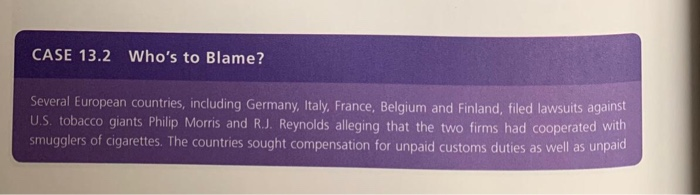
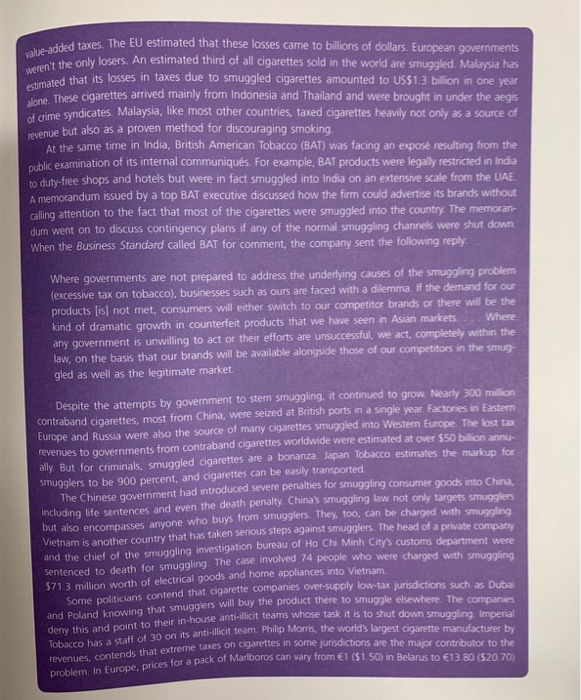
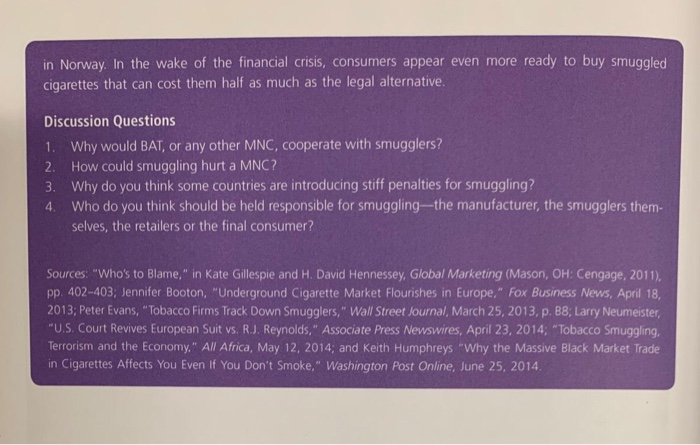 CASE 13.2 Who’s to Blame? Sev eral European countries, including Germany, Italy, France, Belgium and Finland, filed lawsuits against u.S. tobacco giants Philip Morris and R.J. Reynolds alleging that the two firms had cooperated with smugglers of cigarettes. The countries sought compensation for unpaid customs duties as well as unpaid ded taxes. The EU estimated that these losses came to billions of dollars. European governments t thel loser. An estimated third of all cgarettes sold in the world are smuggled. Molaysia has were estimated that its losses in taxes due to smuggled cigarettes amounted to US$1.3 billion in one year ione These cgarettsarrived mainly from Indonesia and Thailad and were broughtin under the aegs of gime syndicates Malaysia, like most other countries, taxed cigarettes heavily not only as a source of ue but also as a proven method for discouraging smoking reven At the same time in India, British American Tobacco (BAT) was facing an exposé resulting from the public examination of its internal communiqués. For example, BAT products were legaly restricted in Inda A memorandum issued by a top BAT executive discussed how the firm could advertise its brands without calling attention to the fact that most of the cigarettes were smuggled into the country The memoran- dum went on to discuss contingency plans if any of the normal smuggling channels were shut down When the Business Standard called BAT for comment, the company sent the following reply Where governments are not prepared to address the underlying causes of the smuggling excessive tax on tobacco), businesses such as ours are faced with a dilemma. If the demand for our products lis] not met, consumers will either switch to our competitor brands or there will be the kind of dramatic growth in counterfeit products that we have seen in Asian markets any government is unwilling to act or their efforts are unsuccessful, we act, completely within the law, on the basis that our brands will be available alongside those of our competitors in the gled as well as the legitimate market Where smug- Despite the attempts by government to stem smuggling, it continued to grow Nearly 300 million contraband cigarettes, most from China, were seized at British ports in a single year Factories in Eastern Europe and Russia were also the source of many cigarettes smuggled into Western Europe. The lost tax revenues to governments from contraband cigarettes worldwide were estimated at over $50 bilion annu ally. But for criminals, smuggled cigarettes are a bonanza. Japan Tobacco estimates the markup for smugglers to be 900 percent, and cigarettes can be easily transported The Chinese government had introduced severe penalties for smuggling consumer goods into China, including life sentences and even the death penalty China’s smuggling law not only targets smugglers but also encompasses anyone who buys from smugglers. They, too, can be charged with smuggling Vietnam is another country that has taken senious steps against smugglers. The head of a private and the chief of the smuggling investigation bureau of Ho Chi Minh City’s customs department were sentenced to death for smuggling. The case involved 74 people who were charged with smuggling $71.3 million worth of electrical goods and home appliances into Vietnam. and Poland knowing that smugglers will buy the product Tobacco has a staff of 30 on its ant d that cigarette companies over-supply low-tax jurisdictions such as Dubai there to smuggle elsewhere int to their in-house anti-illicit teams whose task it is to shut down i-illicit team. Philip Morris, the world’s largest cigarette manufacturer by taxes on cigarettes in some jurisdictions are the major contributor to the k of Marlboros can vary from 1 ($1.50) in Belarus to 13.80 (520.70) in so revenues, contends that extreme taxes in Norway. In the wake of the financial crisis, consumers appear even more ready to buy smuggled cigarettes that can cost them half as much as the legal alternative Discussion Questions 1. 2. 3. 4. Why would BAT, or any other MNC, cooperate with smugglers? How could smuggling hurt a MNC? Why do you think some countries are introducing stiff penalties for smuggling? Who do you think should be held responsible for smuggling-the manufacturer, the smugglers them- selves, the retailers or the final consumer? Sources: “Who’s to Blame,” in Kate Gillespie and H. David Hennessey, Global Marketing (Mason, OH: Cengage, 2011), pp. 402-403; Jennifer Booton, “Underground Cigarette Market Flourishes in Europe,” Fox Business News, April 18, 2013, Peter Evans, “Tobacco Firms Track Down Smugglers,” Wall Street Journal, March 25, 2013, p. B8: Larry Neumeister, U.S. Court Revives European Suit vs. R.J. Reynolds,” Associate Press Newswires, April 23, 2014 “Tobacco Smuggling, Terrorism and the Economy,” All Africa, May 12, 2014; and Keith Humphreys “Why the Massive Black Market Trade in Cigarettes Affects You Even If You Don’t Smoke,” Washington Post Online, June 25, 2014 Show transcribed image text


Leave a Reply
Want to join the discussion?Feel free to contribute!