
Capacity Required Planning Horizon Company Adequate Capacity 20 000 Hours Labour Charges P Q33557917
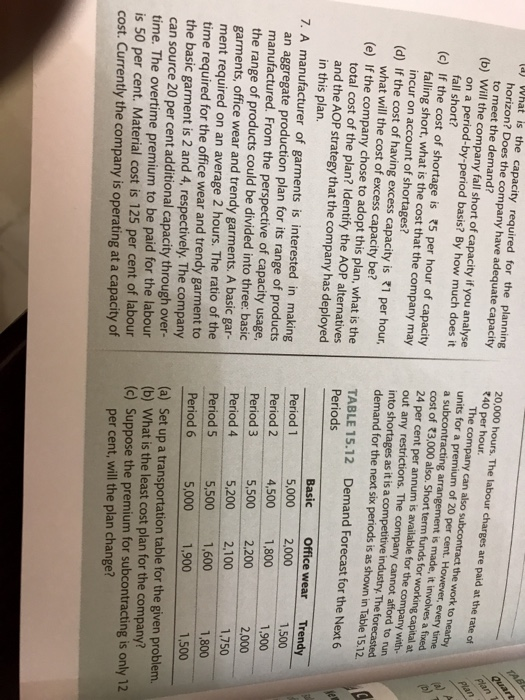
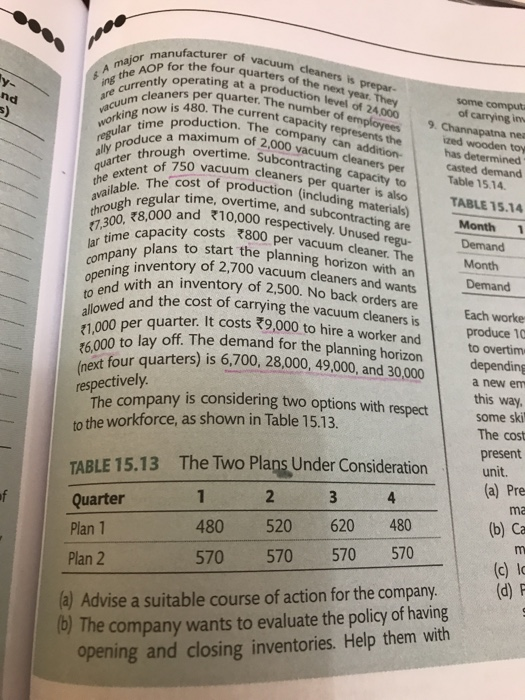 ) What is the capacity required for the planning horizon? Does the company have adequate capacity 20,000 hours. The labour charges are paid at the rate of 40 per hour. to meet the demand? The company can also subcontract the work to units for a premium of 20 per cent. However, every time a subcontracting arrangement is made, it involves a fixed cost of 23,000 also. Short term funds for working capital at 24 per cent per annum is available for the company with- out any restrictions. The company cannot afford to run into shortages as it is a competitive industry.The forecasted demand for the next six periods is as shown in Table 15.12. (b) Will the company fall short of capacity if you analyse on a period-by-period basis? By how much does it nearby fall short? (c) If the cost of shortage is 5 per hour of capacity falling short, what is the cost that the company may incur on account of shortages? (d) If the cost of having excess capacity is 1 per hour, what will the cost of excess capacity be? Demand Forecast for the Next 6 (e) If the company chose to adopt this plan, what is the total cost of the plan? Identify the AOP alternatives and the AOP strategy that the company has deployed TABLE 1 15.12 Basic Office wear Trendy 5,000 2,000 in this plan Period 1 Period 2 1,500 1,900 7. A manufacturer of garments is interested in making an aggregate production plan for its range of products manufactured. From the perspective of capacity usage the range of products could be divided into three: basic garments, office wear and trendy garments. A basic gar- ment required on an average 2 hours. The ratio of the time required for the office wear and trendy garment to 4,500 1,800 5,500 2,200 5,200 2,100 5,500 1,600 5,000 1,900 Period 4 Period 5 Period 6 1,750 1,800 1,500 (a) Set up a transportation table for the given problem. (b) What is the least cost plan for the company? (c) Suppose the premium for subcontracting is only 12 the basic garment is 2 and 4, respectively. The company can source 20 per cent additional capacity through over- time. The overtime premium to be paid for the labour is 50 per cent. Material cost is 125 per cent of labour cost. Currently the company is operating at a capacity of per cent, will the plan change? manufacturer of vacuum ing the AOP for are currently o four quarters of the next year. They AOPerating at a production level of 24,000 cun cleaners80. The current capacity represents the cu nowduction. The company can addition- some comput of carrying in 9. Channapatna nea zed wooden toy has determined casted demand per quarter. The num nd of mum of 2,000 vacuum cleaners per vertime. Subcontracting capacity to vacuum cleaners per quarter is also e a maxi ally pr through Subcont rter quaro tent of 750 clean the e. The cost of production (incl Table 15.14 glar time, overtime, and subcon uding materials) TABLE 15.14 hrousn8.000 and 10,000respectively. Unused osts Month acting are 7,300, 800 per vacuum cleaner. The compa opent with an inventory of 2.500. No back orders are y plans to start the planning horizon with an inventory of 2,700 vacuum cleaners and wantsDemand d and the cost of carrying the vacuum cleaners is uarter. It costs 9,000 to hire a worker and 10 ly off. The demand for the planning horizon to Each worke produce 10 to overtim er q depending four quarters) is 6,700, 28,000, 49,000, and 30,000 respectively to the workforce, as shown in Table 15.13. a new em this way some ski The cost present The company is considering two options with r TABLE 15.13 The Two Plans Under Considerationunite (a) Pre ma (b) Ca Quarter Plan 1 Plan 2 480 520 620 480 570 570 570 570 a) Advise a suitable course of action for the company.(d b) The company wants to evaluate the policy of having es. Help them with opening and closing inventori Show transcribed image text


Leave a Reply
Want to join the discussion?Feel free to contribute!