
Business Strategy Please Read Market Large Commercial Aircraft Attached Picture Answer Cas Q34799745
Business Strategy
Please read The market for large commercial Aircraftfrom attached picture and answer case discussion questionsabove only Question 1
Thanks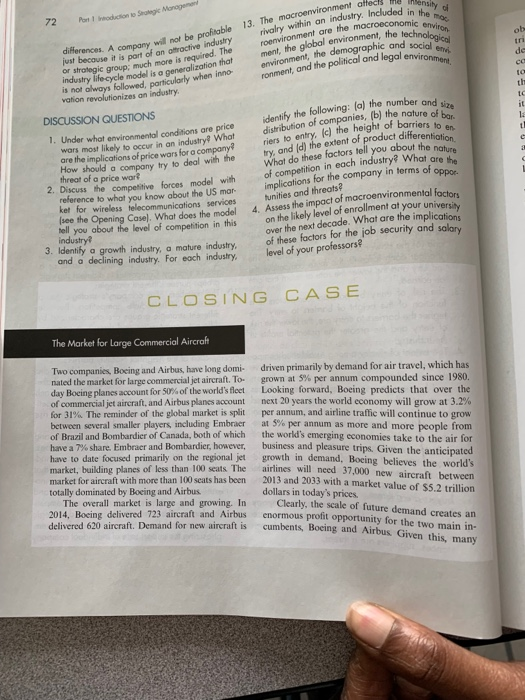
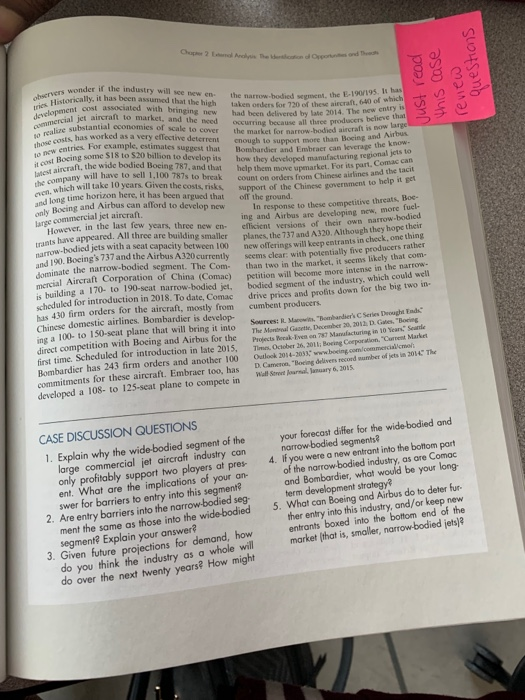
72 Poat 1 oduction to Srategic 13. The macroenvironment affecs n an indus lifeoycle model is o generolization that ment, the global environment, the folowed, particularly when inno environment, the demographic and onment are the macroeconomic ronment, and the political and m identihy the following: (a) the number and si A company will not be profitable onav. The ment differences. A company part of an attractive industry legal environment, or strotegic group nos vation revolutionizes an DISCUSSION QUESTIONS the nature of bar 1. Under what environmental conditions are price ers to entry, (c) the height of barriers to wors most likely to occur in an industry? What are the implications of price wars for a componye How should a company try with the threat of a price war and (d) the extent of product differentiot of competition tunities and threats? factors tell you about the in each industry? What are the to deal with the What otese ach industry? What are the 2. Discuss the competitive forces model with reference to what you know about the US mar implications for the company in terms of oppoe. ket for wireless telecommunications services lsee the Opening Casel. What does the model 4. Assess the impact of ndtou obout the level of compeition in thison the likely level of enrollment at your university macroenvironmental factore over the next decade. What are the implication of these factors for the job security and salory industry, a mature industry, each industry, a declining industry. For level of your professors? CLOSING CASE The Market for Large Commercial Aircraft Two companies, Boeing and Airbus, hane long domi- driven primarily by demand for air travel, which has nated the market for large commercial jet aircraft. To- grown at 5% per annum compounded since i980 day Boeing planes acount for 50% of the world’s fleet Looking forward, Boeing predicts that over the of commercial jet aircraft, and Airbus planes account next 20 years the world economy will grow at 3.2% for 31%. The reminder of the global market is split perannum, and airline traffic will continue to grow between several smaller players including Embraer at 5% per annum as more and more people from of Brazil and Bombardier of Canada, both of which the world’s emerging economies take to the air for have a7% share. Embraer and Bombardier, bowever, business and pleasure trips. Given the anticipated have to date focused primarily on the regional jet growth in demand. Boeing believes the worlds market, building planes of less than 100 seats The airlines will need 37,000 new market for aircraft with more than 100 seats has been 2013 and 2033 with a market val totally dominated by Boeing and Airbus aircraft between ue of $5.2 trillion dollars in today’s prices. The overall market is large and growing. InClearly, the scale of 2014, Boeing delivered 723 aircraft and Airbus delivered 620 aircraft. Demand for new aircraft is cumbents, Boeing andAirbuse future demand creates an enormous profit opportunity for the two main in- ie t cst associated with bringing eial jet aircrafnt to market, and the need occurring because all wonder if the industry will se new en- the narrow-bodlied prn aircraft, 640 ofl lly, it has been assumed that the high taken orders for 720 of the 2014. The new entry 3 segnvens, the E-190/195. 1t has new had been delivered by late new to cover the market for narrow-bodied aircraft is now substantial cconomics of scale three producers believe that o osts, has worked as a very effective deterrent enough to support more than th know- entries For example, estimates suggest that Bombardier and Embraer can leverage and Airbus S18 to $20 billion to develop it cost Bocing some latest aircraft, the wide bodied Bocing 787, and that will have to sell 1,100 787s to break the swhich will take 10 years. Given the costs, risks, its how they developed manufacturing regional jets to help them move upmarket. For its part, Comac can count on orders from Chinese airlines and the tacit to help it get anly Bocing and Airbus can afford to develop new horizon here, it has been argued that off the ground. support of the Chinese goversment to However., in the last few years, three new en- eflicient versions of their own na n response to these competitive threats, Boe- ing and Airbus are developing new, more fuel- ree are building smaller planes, the 737 and A320. Although they hope their ther new offerings will keep entrants in check, one thing dominate the narrow-bodied segment. The Com- than two in the market, it seems likcly that com ts have appeared. All thr narrow-bodied jets and 190. Boeings 737 and the Airbus with a seat capacity between 100 20 currently seems clear: with potentially five producers ra mercial Aircraft Corporation of China (Comac) petition will become more intense in the narrow. is building a 170- to 190-seat na schoduled for introduction in 2018. To date, Comac drive prices and profits down for the big two in- has 430 firm orders for the aircraft, mostly from cumbent producers Chinese domestic airlines. Bombardier is develop- ing a 100- to 150-seat plane that will bring it into direct competition with Bocing and Airbus for the first time. Bombardier has 243 firm orders and another l commitments for these aircraft. Embraer too, has D. Cameron, “Boeing delvers rescond sumber of jets in 2014 The bodied et, bodied segment of the industry, which could well Sources: R Marowith, Bombandier’s C Series Deought Ends The Montreal Gasette, December 20, 2012, D. Gates, “Bocing Surcesi GasetraiMk Projects Recak-Even on 787 Manafacturing in 10 Years Seatle Scheduled for introduction in late 2015, m, Ociober 26,201l, Boring Corporation Currest mercialicme 00 utlook 2014-2033 พเส Smrhnlleury6 2015. developed a 108-to 125-seat plane to compete in CASE DISCUSSION QUESTIONS 1. Explain why the wide-bodied segment of the your forecast differ for the wide-bodied and narrow bodied segmentsi? 4. Ifyou were a new entrant into the botom part large commercial jet aircraft industry can only profitably support two players at pres ent. What are the implications of your an- swer for barriers to entry into this segment? Are entry barriers into the narrow-bodied seg- the narrow-bodied industry, as are Comac and Bombardier, what would be your long term development strategy? s those into the wide-bodied 5. What can Boeing and Airbus do to deter fur ther entry into this industry, and/or keep new 2. segment? Explain your answer entrants boxed into the botom end of the narm 3. Given future projections for demand, how do you think the industry as a whole will do over the next twenty years? How might Show transcribed image text


Leave a Reply
Want to join the discussion?Feel free to contribute!